

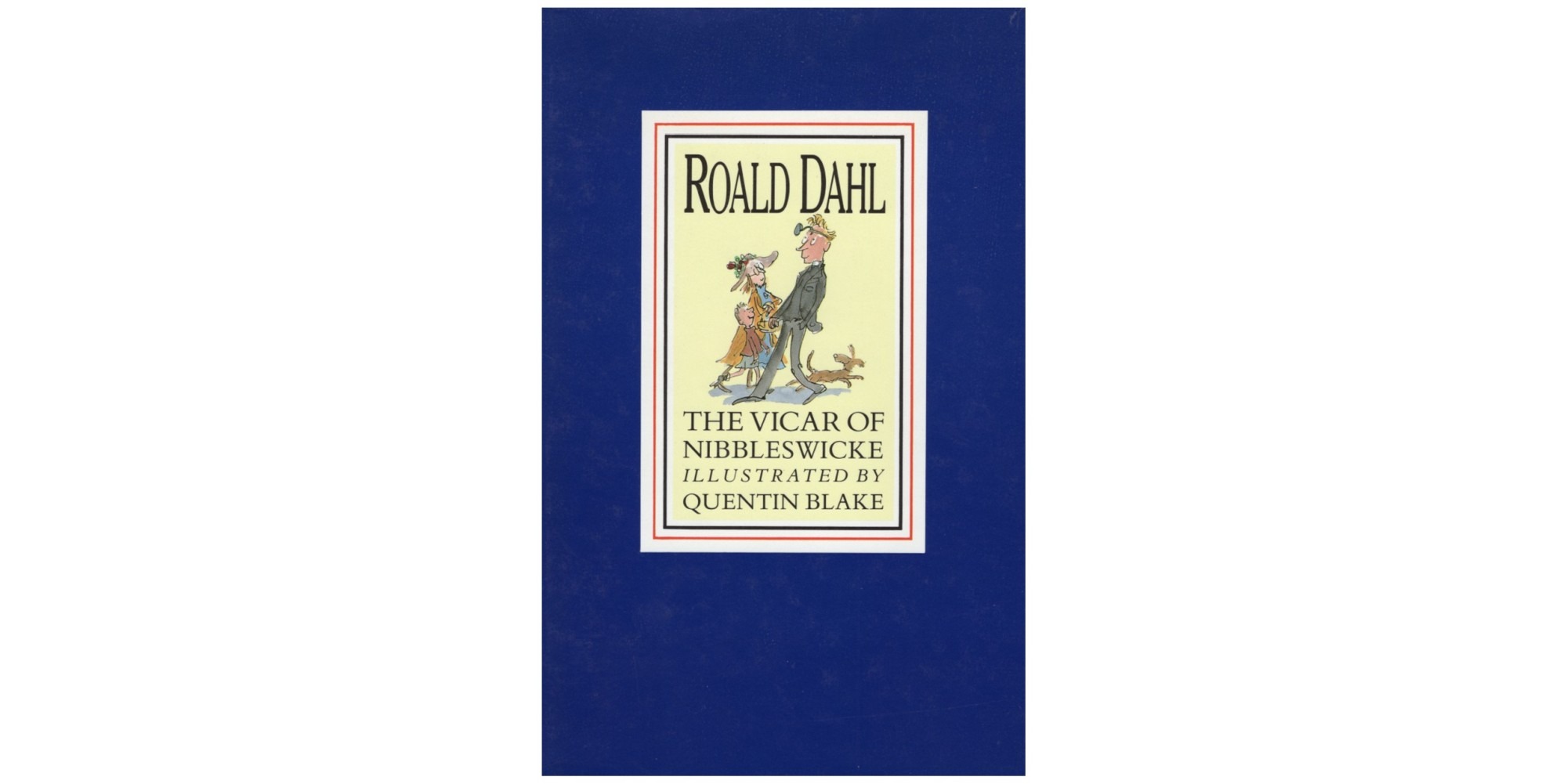
When it comes to children’s books Roald Dahl has long been celebrated as a storytelling maestro, the master of weaving whimsy and wonder into the fabric of children’s literature. Readers of his books are often left feeling positively hopscotchy – cheerful, buoyant and ready to leap into his imaginative worlds. Beyond his unforgettable stories, Dahl also gifted us with Gobblefunk, his frothbuggling language of whoopsy whiffling words, which you can find immortalised in The Oxford Roald Dahl Dictionary. His creativity was matched by generosity, as he devoted much of his life to charitable causes. That legacy continues today through Roald Dahl’s Marvellous Children’s Charity, which supports seriously ill children across the UK. It is fitting then, that one of his final works, published in 1991 a year after his death, combined his trademark humour with heartfelt purpose. The Vicar of Nibbleswicke is a short but memorable tale that raises awareness of dyslexia while raising funds for the Dyslexia Institute, thanks to Dahl and illustrator Quentin Blake donating their rights.
The Vicar of Nibbleswicke is a short book and while it may be brief at just 48 pages in length, it is packed with Dahl’s unique brand of linguistic lunacy. The story takes us to the small village of Nobbleswicke where we are introduced us to the new parish vicar, Reverend Robert Lee. As a child, he struggled with dyslexia but he overcame it with hard work, perseverance and a lot of determination with the help of the Dyslexia Institute in London and some excellent teachers. However, the stress and worry of his new role triggers a very peculiar relapse in the rare form of “Back-to-Front Dyslexia.” Without him realising it, certain words tumble out of his mouth backwards, leaving his parishioners shocked and bewildered. One particularly memorable moment comes when Reverend Lee, attempting to guide his flock through communion etiquette, solemnly instructs his devout parishioners not to “plug” the wine but to “pis” and pis gently instead. There is uproar in the village as a result – which is both hilarious and shocking, a perfect example of Dahl’s ability to balance mischief with meaning.
Overall, while The Vicar of Nibbleswicke is a quick fun and quite a fun story; short, sweet and laugh-out-loud funny. It entertains without offending and raises awareness without preaching. And it does all of this while taking a look at the real issue of Dyslexia – a condition that affects an estimated one in ten people in the UK (source: NHS). But is not the first time Dahl has played with backwards words. Readers may recall that in Esio Trot, tortoise suffers a similar linguistic quirk. Dahl’s storytelling is genius, he has the ability to take a serious issue and present it in a way that is accessible, engaging and ultimately empathetic, especially for younger readers. Throughout this short tale, he never belittles or mocks the condition, choosing to instead use humour to help with understanding and raise awareness.
The Vicar of Nibbleswicke offers a light-hearted look at dyslexia and its effects. While a serious issue it also leaves readers with a hearty dose of giggles and some understanding of the condition. Some might raise eyebrows at words like “krap” and “pis,” but this cheekiness is quintessential Dahl. But his unique dark humour works extremely well because it pushes at boundaries, inviting us to laugh at absurdity while reflecting on the challenges of communication.
And as always, Quentin Blake has supplied the lively illustrations throughout the book, and are the perfect companion to Dahl’s narrative. His energetic line drawings dance across the pages, capturing the vicar’s muddled expressions and the villagers’ shocked reactions with characteristic wit, warmth and ultimately humour. They do an excellent job of ensuring that readers will laugh along with Reverend Lee rather than at him. Together, Dahl and Blake have created a book that entertains while serving a greater purpose, with proceeds supporting dyslexia charities (Roald Dahl and Quentin Blake donated their rights).
The Vicar of Nibbleswicke is a delightful flirtation with the absurd, but offers a fantastic reminder that even serious topics can be approached with playfulness and compassion when handled with empathy. For readers young and old this book is a testament to the joyful celebration of words, wit and the power of storytelling.
If you want to find about more about dyslexia or looking for help and support, visit the British Dyslexia Association or The Dyslexia Association.
Rating: 5/5
RRP: £7.99 (Paperback) / £3.99 (Kindle)
For more information, visit www.roalddahl.com. Available to buy from Amazon here.
PUBLISHER:
PUBLICATION DATE:
ISBN:
PRINT LENGTH:
COVER ART: